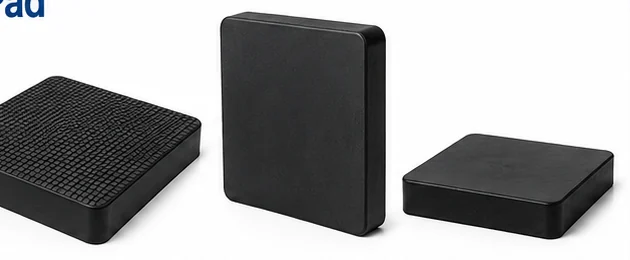
Solid square pad
One flat side and one fine-grid side, without a center hole as standard. Optional drilling is available to suit the installation, with hole position and diameter specified by order.
Request a Quote for S-01 →S series · Select by structure
Square rubber pads offer solid and center-hole starting points for equipment support. Confirm the footprint, thickness, surface contact, installation interface and load before selecting a final specification.
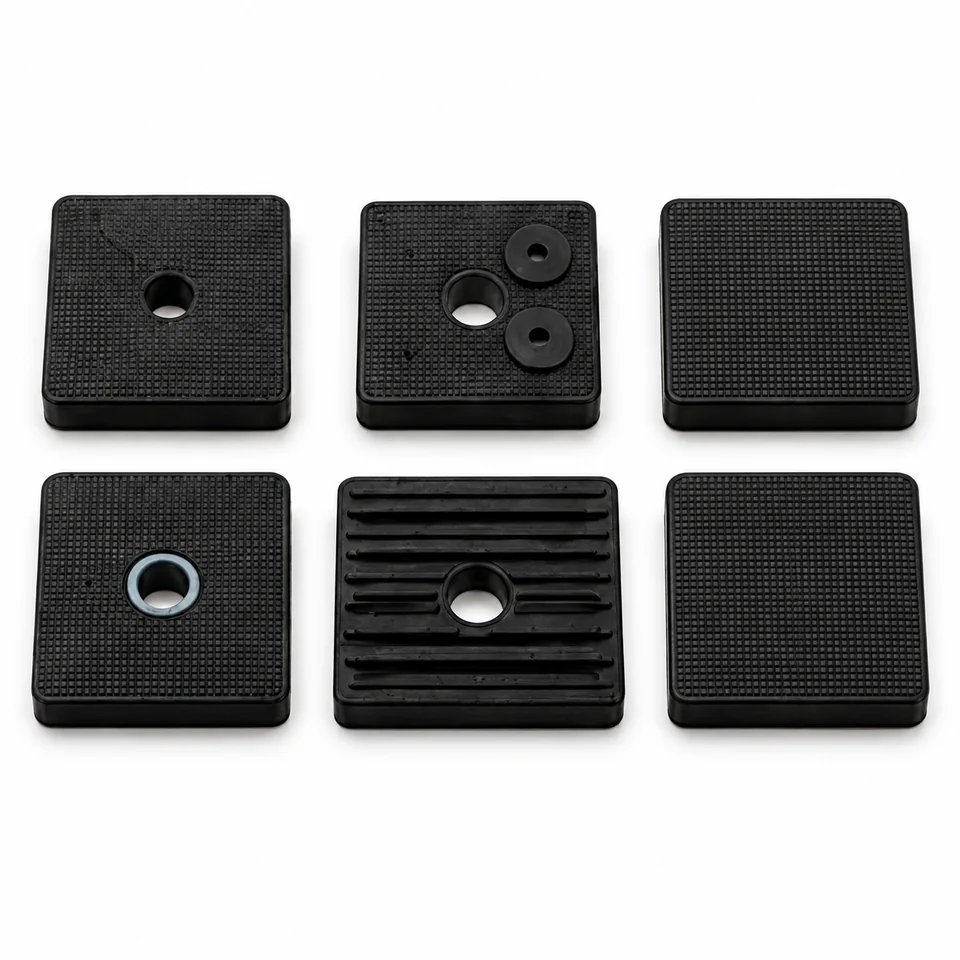
Choose the structure first
Use the closest structure as a starting point. Confirm dimensions, rubber material, hardness and mounting details against the final drawing or sample.
One flat side and one fine-grid side, without a center hole as standard. Optional drilling is available to suit the installation, with hole position and diameter specified by order.
Request a Quote for S-01 →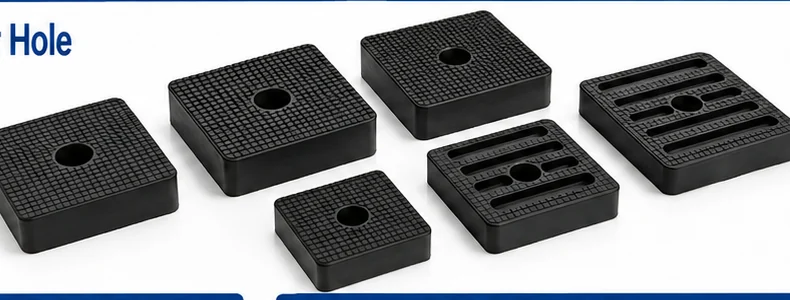
A square pad with a central opening. Specify the hole and mating fastener or locating feature.
Request a Quote for S-02 →Catalog specifications
All dimensions are in millimeters (mm). Listed footprint and thickness options do not imply that every combination is available. Confirm the exact combination, tolerances and availability when ordering. Load capacity requires application-specific review.
T denotes overall thickness, including the surface texture. The catalog uses H for this dimension.
Catalog square-footprint options: 100, 150, 200 and 300 mm, with thickness options of 20, 30 and 50 mm. For 600 × 600 mm pads, listed thicknesses are 10, 20, 30, 40 and 50 mm.
Selected 250 and 300 mm sizes are available with thickness up to 100 mm. Optional drilling follows the specified installation requirement. Confirm the exact size and hole pattern.
Catalog references: 50 × 50 × 20 mm with a Ø10 mm through-hole; 71 × 71 × 10 mm with a Ø12 mm through-hole. Other square sizes and hole diameters are available by request.
Standard: synthetic rubber. Optional materials: NR (natural rubber), NBR (nitrile rubber) and EPDM. Specify exposure conditions for compound selection.
Typical hardness: 65 ± 5 Shore A. Custom hardness: 40–90 Shore A, subject to material and application requirements.
Dimensions, material, hardness and color can be specified by order. For S-02, confirm the center-hole diameter and mating fixing or locating feature.
Actual production example
This synthetic rubber square pad is intended for vibration damping, cushioning and slip resistance. The specifications below describe the photographed example, rather than every square pad in the range.
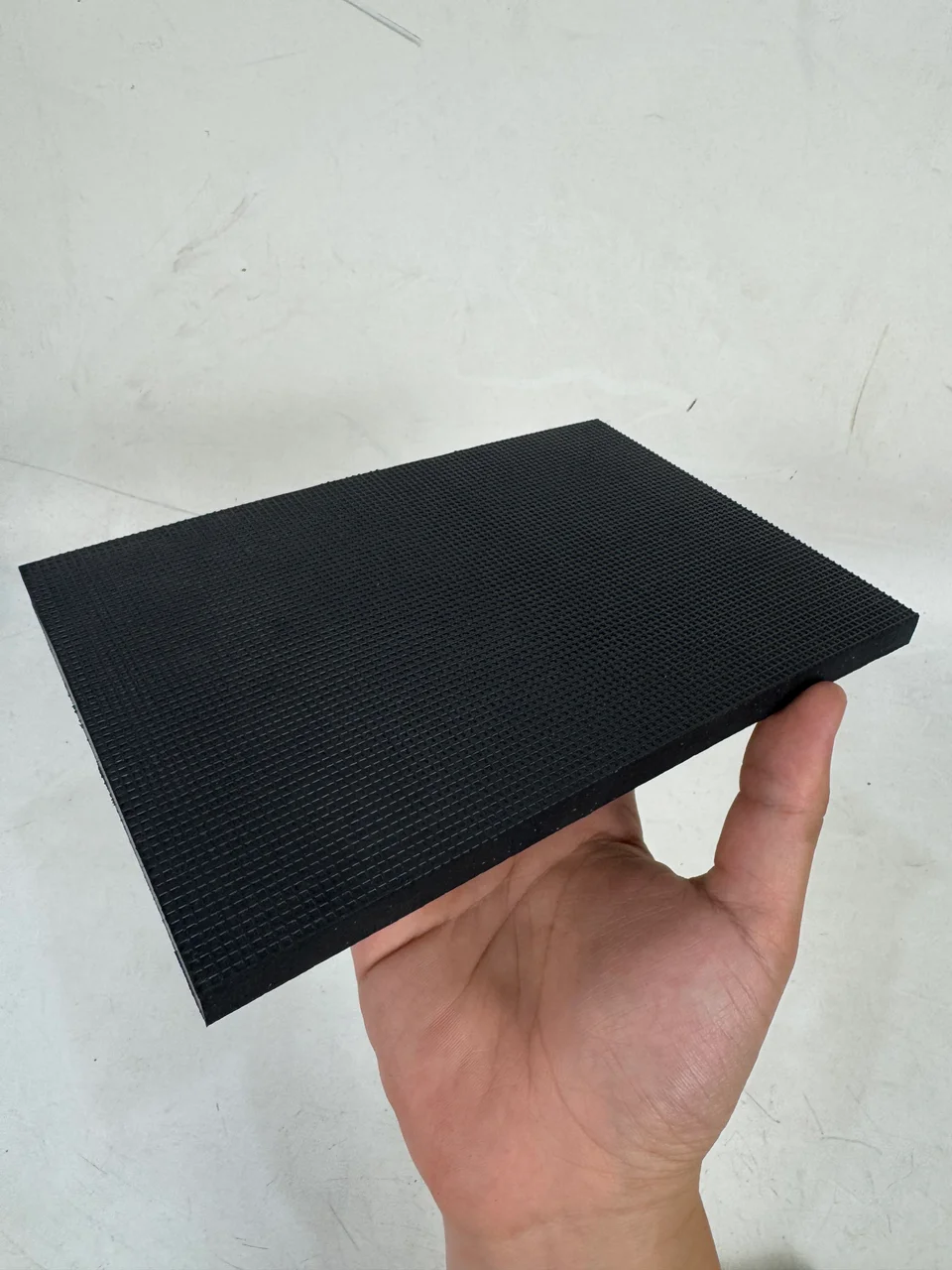
Dimensions and hardness alone do not establish load capacity or isolation performance. Selection also requires review of the load per pad, support arrangement, contact surfaces and service conditions.
Need a similar pad? Send a drawing or dimensions, application, expected load per pad and quantity. Include any hole-pattern or surface requirements.
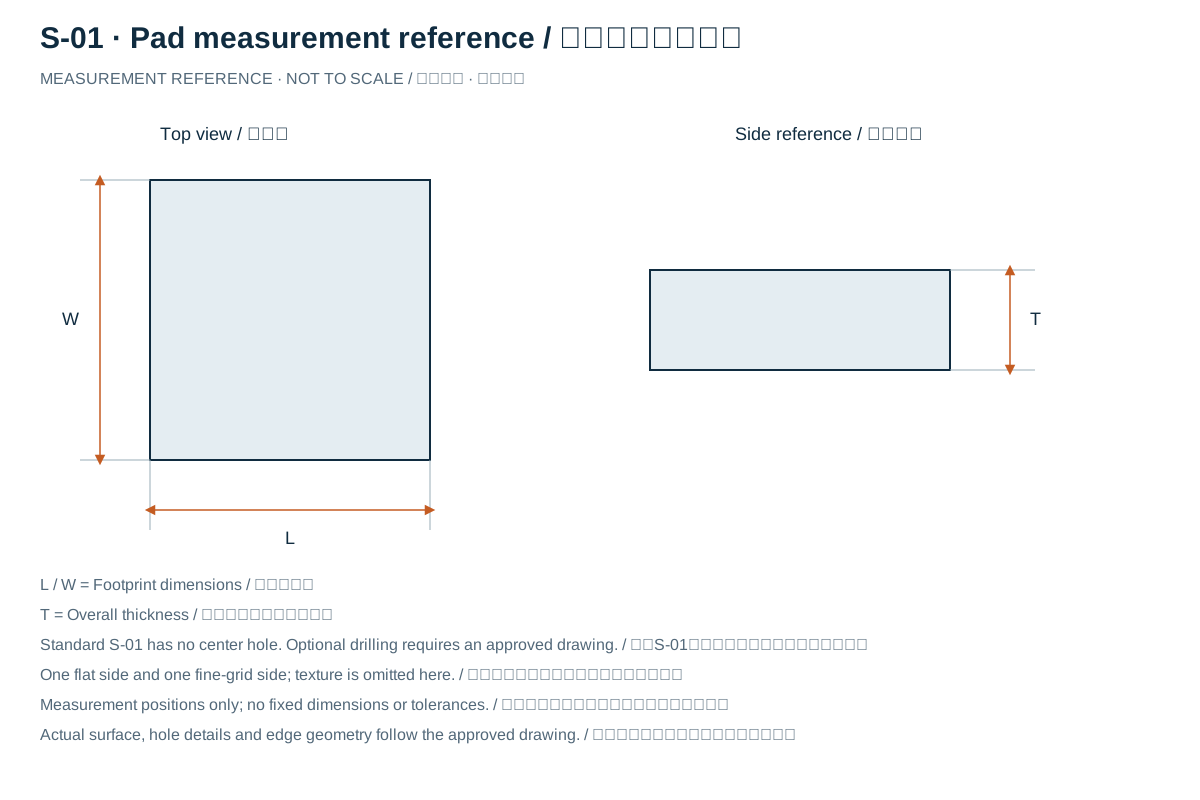
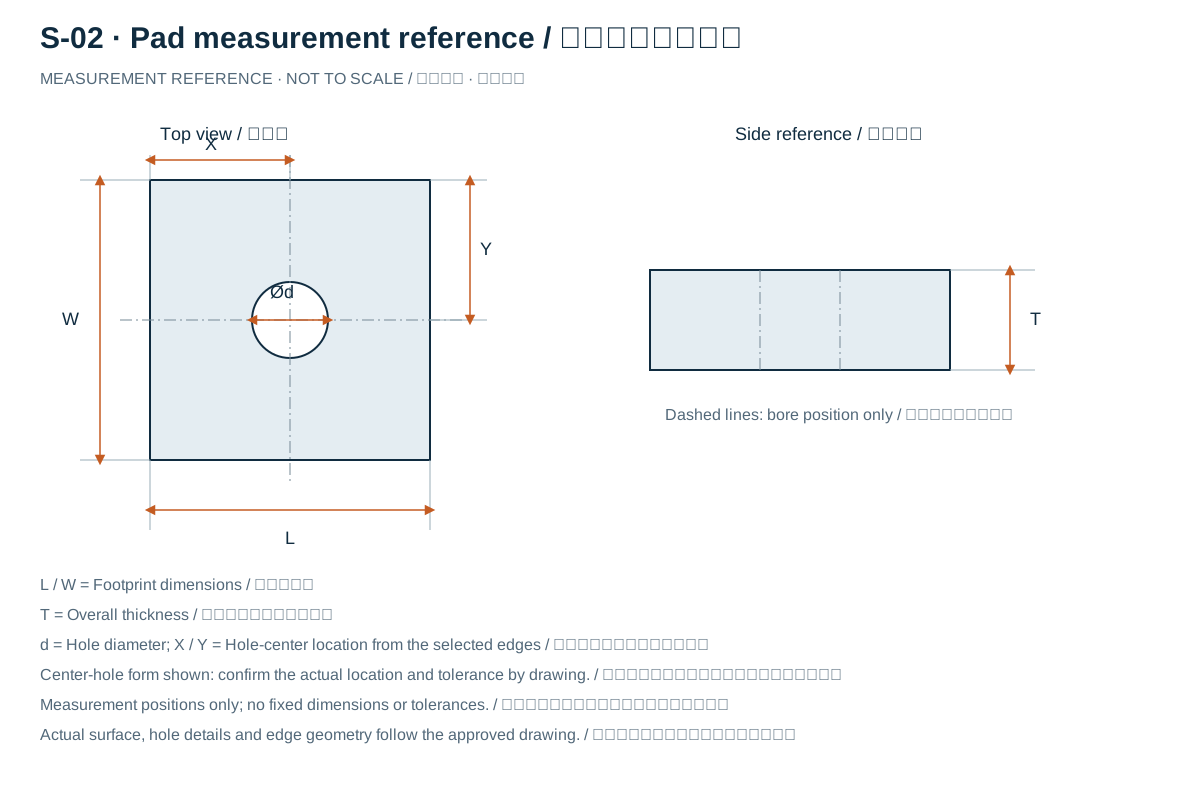
Discuss a similar square padTop views and side references, not to scale, for inquiry measurements only. Actual dimensions, hole locations, surfaces and tolerances follow the approved drawing.
 Tap diagram to view full size ↗
 Tap diagram to view full size ↗
Standard S-01 has no center hole, with one flat side and one fine-grid side. Optional drilling requires an approved drawing. For S-02, confirm the hole diameter and center-to-edge X and Y separately. Texture is omitted; T denotes overall thickness.
Standard S-01 is a solid square pad with one flat side and one fine-grid side, without a center hole. S-02 has a central opening. Specify the required surface pattern, hole dimensions and mating hardware on the order drawing.
Yes. S-01 can be supplied with holes drilled to your drawing. Include the pad dimensions, hole diameter, number of holes, hole positions, edge distances and relevant tolerances. We confirm the requested configuration before accepting the order.
Send the required length, width and thickness for review. Catalog options do not imply that every combination is available. Include hole details, surface requirements and fit-critical tolerances so the complete configuration can be confirmed.
Compare the equipment foot, available support area, fixing or locating features and installation space. Shape alone does not indicate which pad will support more load or provide better isolation. Share the installation drawing and operating conditions before selecting the specification.
Material and hardness are confirmed against your requirements. Provide the rubber type, Shore A hardness and hardness tolerance if specified. If these are unknown, describe the service conditions, load distribution and contact surfaces. A harder or thicker pad does not automatically provide better vibration isolation; the complete configuration must be reviewed for the application.
Send the pad dimensions, hole layout, material and hardness requirements, installation details, and quantity for review.
Request a Quote for Square PadsFor engineering review
Provide length, width and thickness, plus any dimensional or tolerance requirements.
For a center-hole pad, specify the opening and mating hardware; describe any required surface pattern.
Share equipment weight, number of support points and expected load distribution.
Describe the machine, mounting position and the cushioning or isolation concern.
Note relevant temperature, oil, weather or chemical exposure and any known material or hardness requirement.
State trial and production quantities, including packing needs if known.
Application starting points
Suitability depends on the installation, operating conditions and the information supplied for review.
Start with the available information
Share the requirement for a practical review. If the exact product family is unclear, choose “Not sure — need engineering review” in the inquiry form.
1F, Building 1, Chuangye Industrial Park,
No. 13 Hongsan Avenue, Hongchou Town,
Tiantai County, Taizhou, Zhejiang, China
Selection & purchasing guides
Guides to compare structures, check dimensions and prepare application details.
Six pad structures, reference dimensions and measurement steps.
Read guide →Five interfaces, thread dimensions and installation requirements.
Read guide →Compare contact surfaces and connections to choose a starting point.
Read guide →Drawings, specifications, quantities and a ready-to-use inquiry template.
Read guide →Measure rubber height, overall height and both mounting connections.
Read guide →Compare NR, EPDM and NBR and prepare your service conditions.
Read guide →Read hardness values, tolerance notation and testing requirements.
Read guide →