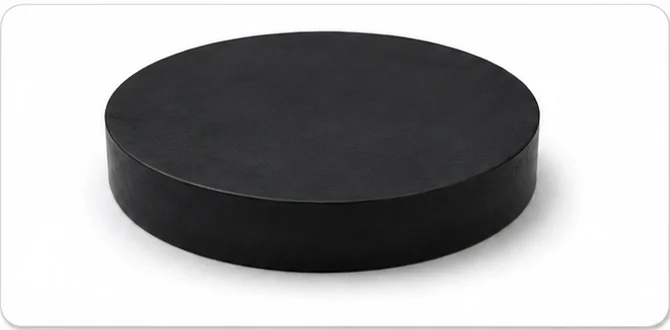
Solid round pad
A round format without a central opening. Confirm diameter, thickness and contact area against the installation.
Request a Quote for R-01 →R series · Select by structure
Compare solid, through-hole, annular and counterbored round rubber pads in the R-01 to R-04 series. Send the outside diameter, thickness, hole or counterbore dimensions, installation details and quantity for review and a quote.
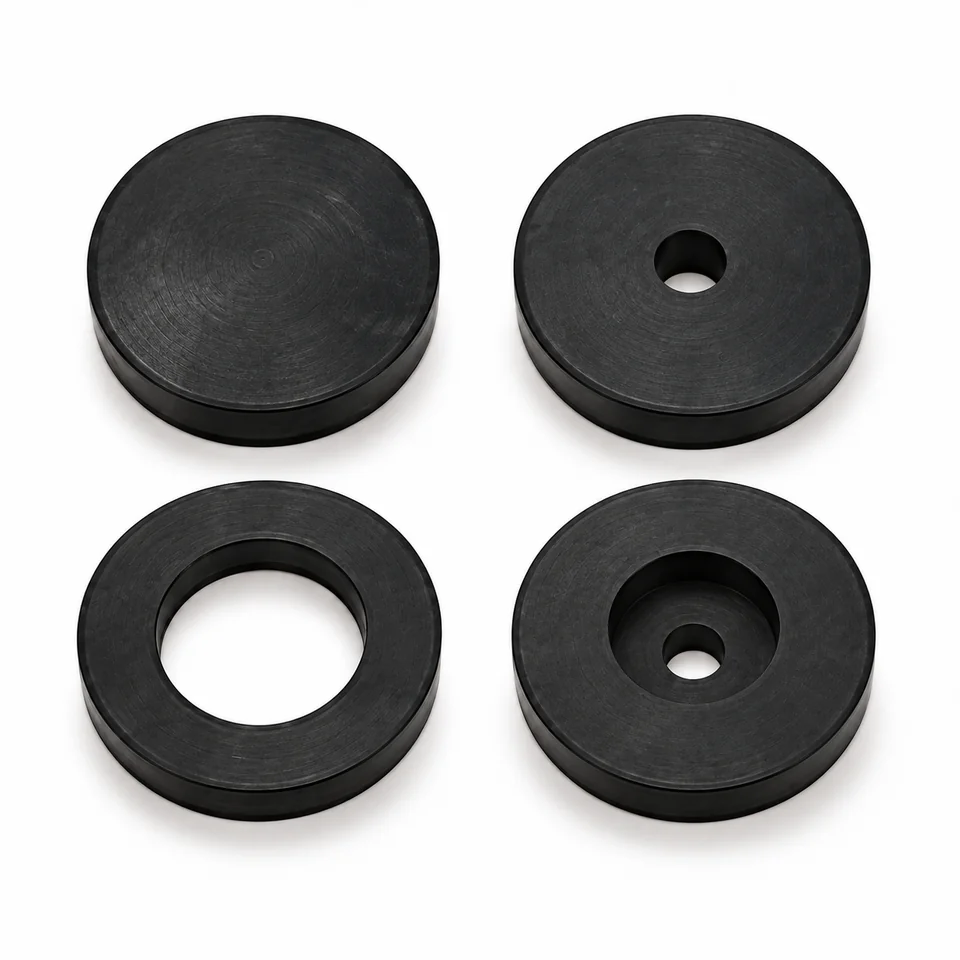
Choose the structure first
Use the closest structure as a starting point. Confirm dimensions, rubber material, hardness and mounting details against the final drawing or sample.
A round format without a central opening. Confirm diameter, thickness and contact area against the installation.
Request a Quote for R-01 →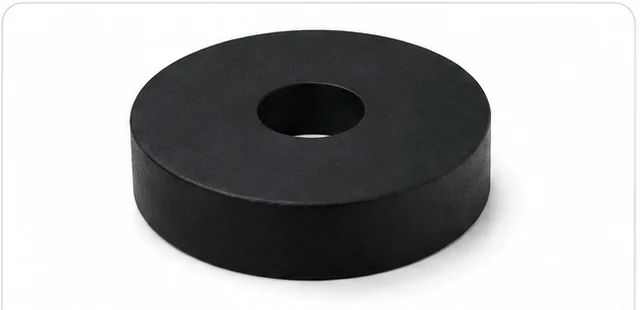
A round pad with a central through-hole. Specify the hole diameter and mating fastener or locating feature.
Request a Quote for R-02 →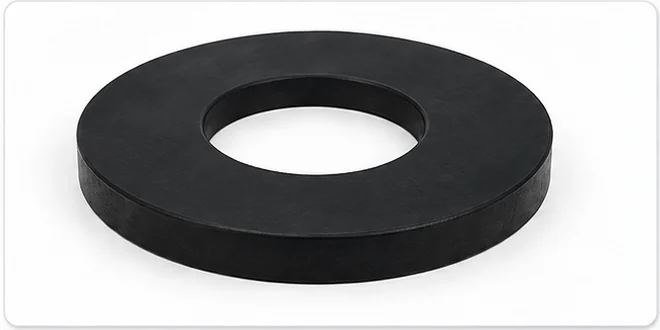
A ring-shaped format with an open center. Confirm inner and outer diameters, thickness and the supported contact area.
Request a Quote for R-03 →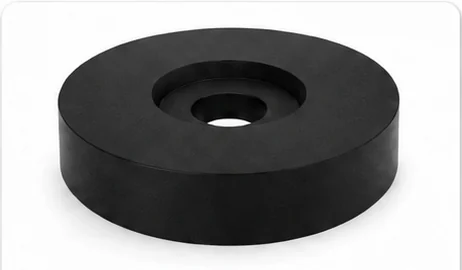
A recessed central opening for an installation interface. Provide the recess profile and mating hardware dimensions.
Request a Quote for R-04 →Catalog specifications
All dimensions are in millimeters (mm). Catalog size options are reference specifications, not a complete list of available combinations. Confirm the exact size, tolerances and availability when ordering. Load capacity requires application-specific review.
Outside diameter options: Ø100, 200, 250, 300, 500, 600 and 800 mm. Thickness options: 10, 20, 25, 30 and 50 mm. Catalog maximum: Ø800 × 50 mm.
Outside diameter: Ø15–Ø300 mm. Center through-hole for positioning and mounting. Hole diameter and thickness made to requirement.
Representative size: Ø250 × 30 × Ø100 mm. Catalog maximum: Ø600 × 30 mm, with the inside diameter specified for the application.
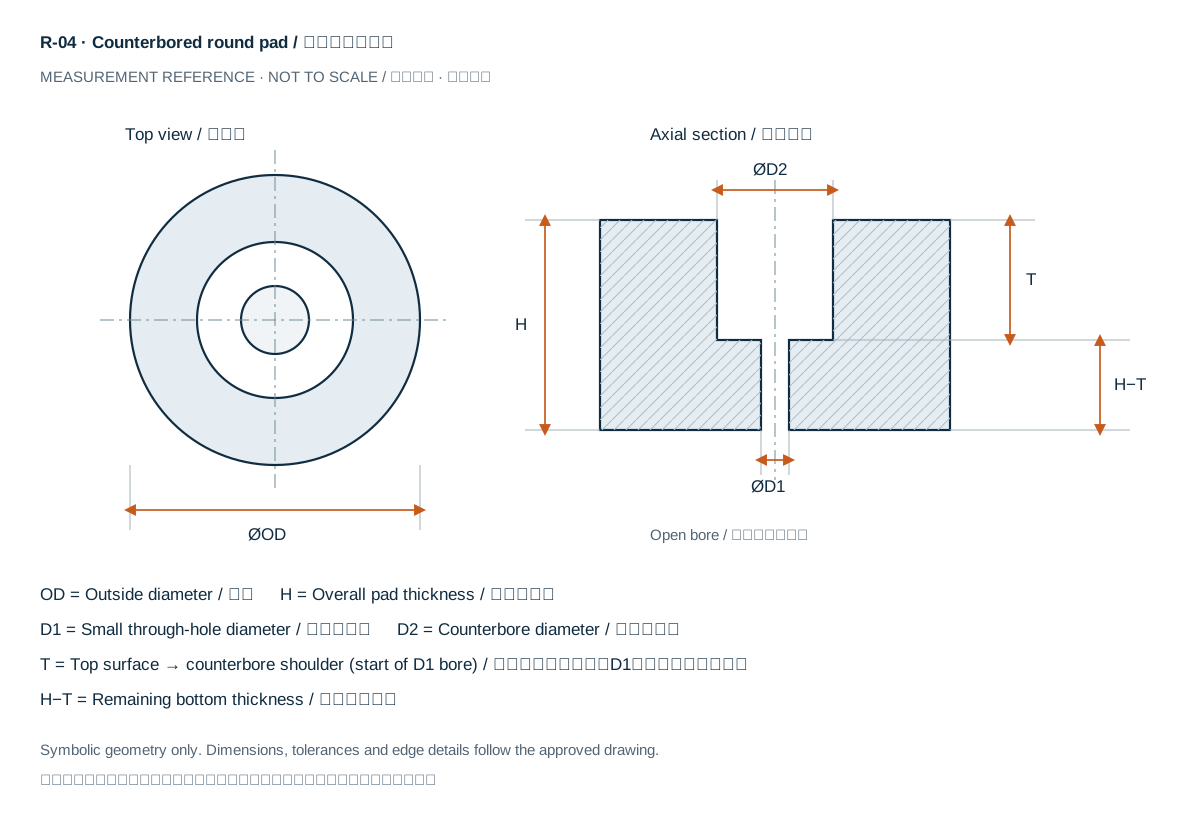
Catalog reference: OD 80, H 30, D1 12, D2 27 and T 15 mm. Catalog design rule: H − T ≥ 10 mm. Confirm the D1, D2 and T features on the approved drawing before ordering.
Standard: synthetic rubber. Optional materials: NR (natural rubber), NBR (nitrile rubber) and EPDM. Specify exposure conditions for compound selection.
Typical hardness: 65 ± 5 Shore A. Custom hardness: 40–90 Shore A, subject to the selected material and application requirements.
Top views and side references, not to scale, for inquiry measurements only. Actual dimensions, hole locations, surfaces and tolerances follow the approved drawing.
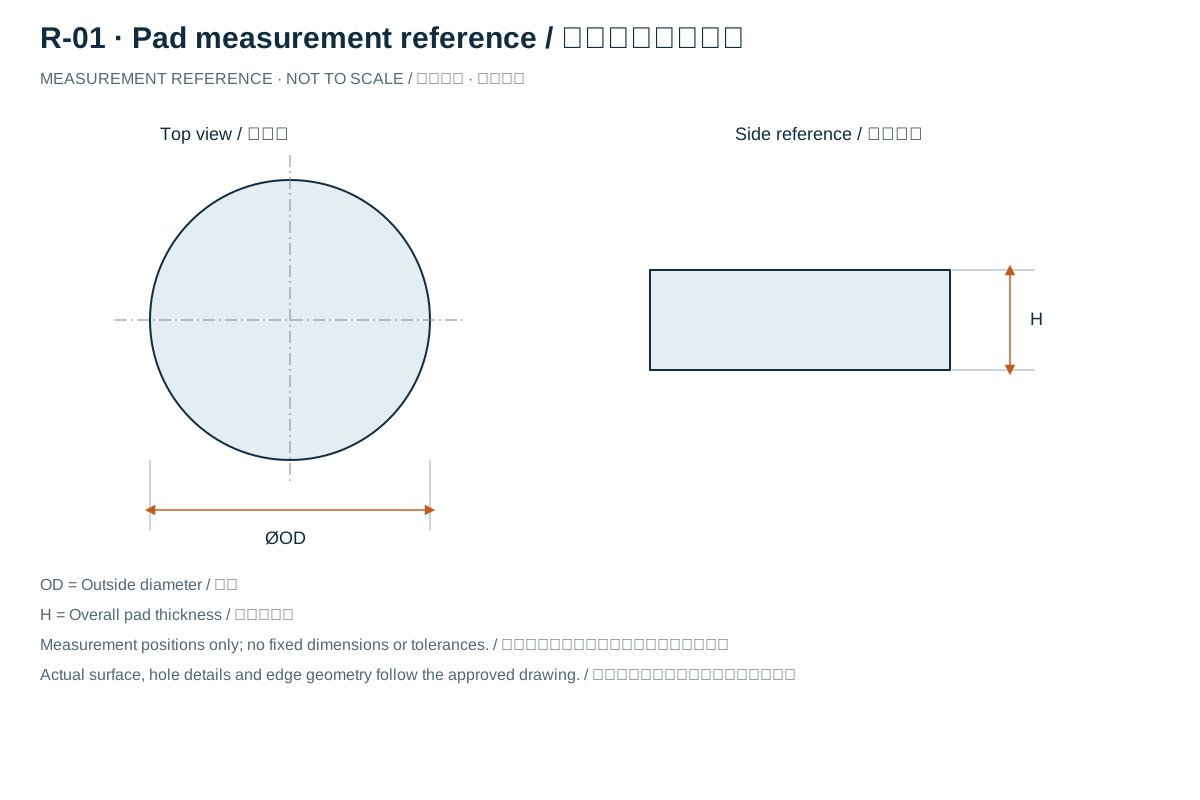 Tap diagram to view full size ↗
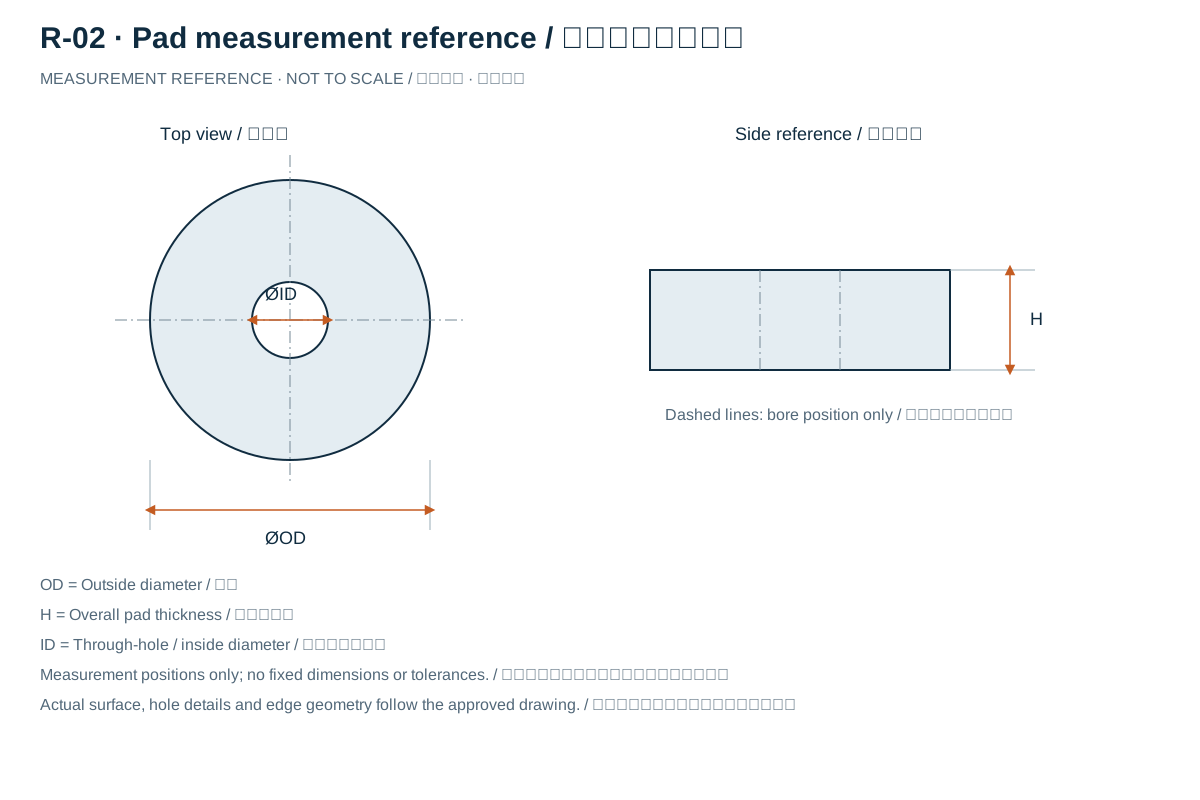 Tap diagram to view full size ↗
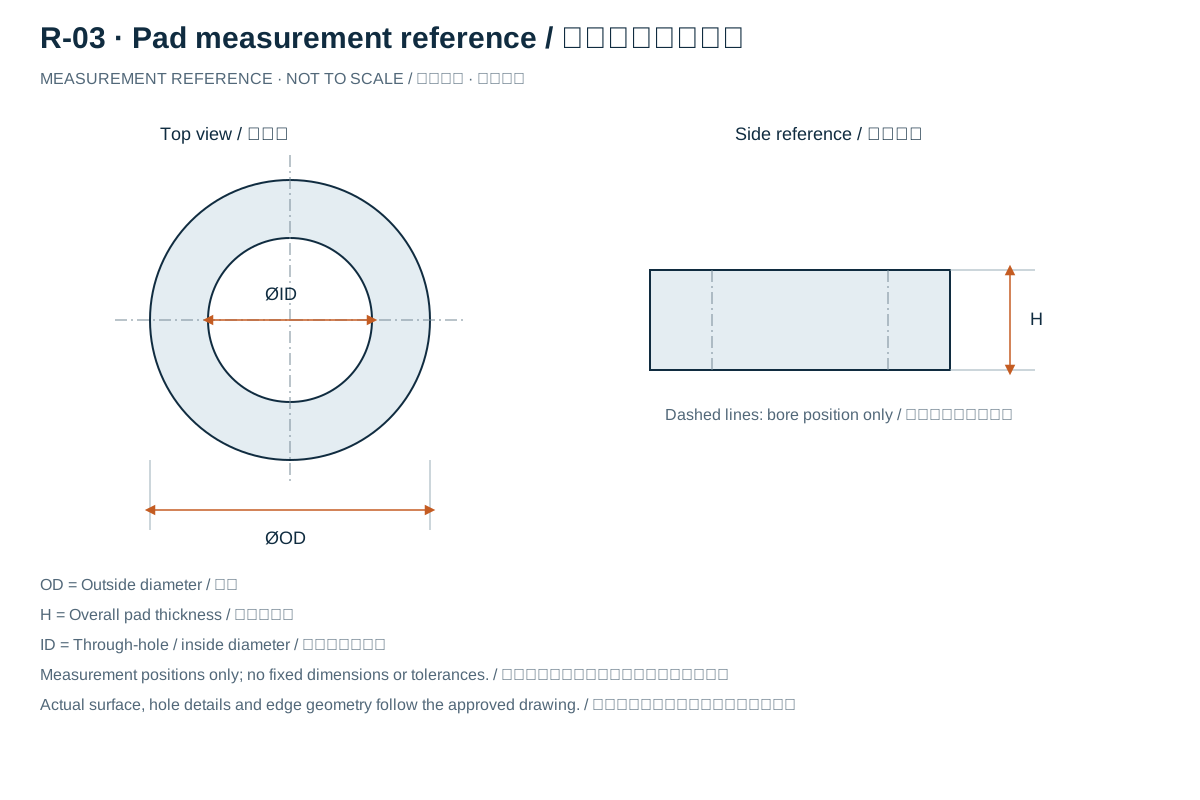 Tap diagram to view full size ↗
Top view and axial section, not to scale. D1 is the small through-hole diameter; D2 is the counterbore diameter. T is measured from the top surface to the counterbore shoulder, where the D1 bore begins. H−T is the remaining bottom thickness.
 Tap diagram to view full size ↗
This reference is not a manufacturing drawing or a load rating. Dimensions, depths, edge details and tolerances follow the approved drawing. Catalog references do not guarantee stock for every configuration.
Start with the installation interface. R-01 is solid, R-02 has a central through-hole, R-03 is annular, and R-04 has a counterbored opening. Share the mating surfaces and any fastener or locating feature so the structure can be reviewed against your drawing.
Provide the outside diameter and thickness, plus the inside diameter or through-hole size where applicable. For a counterbored part, include both opening diameters and the recess depth. State the units and mark fit-critical dimensions and tolerances on the drawing.
A size or series code alone does not define load capacity. Provide the equipment weight, number and positions of pads, expected load at each support point if known, installation arrangement and operating conditions. Do not assume the load is shared equally between pads. Load capacity and suitability must be assessed for the specific application; neither is confirmed by choosing a catalog size.
Material and hardness are reviewed against your requirements. Send the required rubber type, Shore A hardness and hardness tolerance if known. If these are not specified, describe the temperature, fluid contact and outdoor exposure for review. Available material and hardness combinations must be confirmed for the order.
Send a dimensioned drawing or clear photos with measured dimensions, the installation details and the replacement quantity. Describe the reason for replacement and any known material specification. A visual match alone does not establish equivalent fit or performance.
Send your round-pad drawing or measured dimensions, installation details, and trial-order or production quantity for review.
Request a Quote for Round PadsFor engineering review
Choose the closest R-series form and provide outer diameter, thickness, hole or recess dimensions as applicable.
Describe the mating surfaces, fastener, shaft or locating feature and available space.
Share equipment weight, number of pads and expected load at each support point.
Provide equipment type, movement or vibration concern and relevant temperature, oil or weather exposure.
Include an existing specification when available; otherwise share conditions for material review.
State sample or trial quantity and expected production quantity.
Application starting points
Suitability depends on the installation, operating conditions and the information supplied for review.
Start with the available information
Share the requirement for a practical review. If the exact product family is unclear, choose “Not sure — need engineering review” in the inquiry form.
1F, Building 1, Chuangye Industrial Park,
No. 13 Hongsan Avenue, Hongchou Town,
Tiantai County, Taizhou, Zhejiang, China
Selection & purchasing guides
Guides to compare structures, check dimensions and prepare application details.
Six pad structures, reference dimensions and measurement steps.
Read guide →Five interfaces, thread dimensions and installation requirements.
Read guide →Compare contact surfaces and connections to choose a starting point.
Read guide →Drawings, specifications, quantities and a ready-to-use inquiry template.
Read guide →Measure rubber height, overall height and both mounting connections.
Read guide →Compare NR, EPDM and NBR and prepare your service conditions.
Read guide →Read hardness values, tolerance notation and testing requirements.
Read guide →