Selection & purchasing guide
How to Select Rubber Anti-Vibration Pads
Start with the contact surface, available space and installation requirements. Compare A-01, A-02, B, C-01, C-02 and D, then send your dimensions and operating conditions for review.
A model code or hardness value alone does not establish allowable load or vibration-isolation performance. Final selection requires an application review.
Request a pad selection review1. Compare the contact surfaces
Choose a structure to discuss, rather than treating the examples below as a load rating or a stock guarantee. All sizes are in millimetres.
| Model | Structure and selection notes | Catalog size examples (mm) | Next step |
|---|---|---|---|
| A-01 Single-Sided Raised-Dot Pad | Raised dots on the front; fine-grid texture on the reverse. Front and reverse photographs show the confirmed single-sided structure. | 100×100×16; 600×600×16/20/25 | Inquire about A-01 |
| A-02 Double-Sided Raised-Dot Pad | Raised-dot contact surfaces on both faces. General raised-dot references are listed separately from the 6×6 cuttable format. | 230×470×18; 600×600×16/20/25/30 | Inquire about A-02 |
| B 6×6 Cuttable Raised-Dot Pad | 6×6 raised-dot pattern: 36 dots per unit. Cuttable format; confirm unit size, cut lines and edge finish against the drawing or sample. | 100×100×15/20; 200×200×15/20 | Inquire about B |
| C-01 Single-Sided Ribbed Pad | Ribs on one face and a fine-grid reverse. The shared reverse image is a texture reference, not a dedicated C-01 photograph. | 200×400×20; 600×600×25/30 | Inquire about C-01 |
| C-02 Double-Sided Ribbed Pad | Ribbed contact surfaces on both faces. Confirm thickness and the actual rib profile against the drawing or sample. | L × W: 200×400; 600×600. T: 25/30 | Inquire about C-02 |
| D Heavy-Duty Deep-Groove Ribbed Pad | Deep grooves between high-section ribs. Heavy-duty describes the structure, not a verified load rating. | 100×100×20; 200×200×20; 300×300×30; 600×600×30 | Inquire about D |
Dimensions are length × width × total thickness. Slashes separate alternative thicknesses; C-02 lists footprint and thickness separately. Confirm the selected combination, rib profile, tolerances and cutting requirements before quotation.
View product photographs and full size references →2. Confirm material and hardness
Common material: synthetic rubber.
Typical hardness: 65 ± 5 Shore A.
C-02 common total thickness: 25 or 30 mm.
Custom materials, hardness and dimensions are confirmed by order. Describe exposure to oil, outdoor weather, temperature or chemicals, and send any existing specification or sample. These common parameters do not by themselves guarantee compatibility with your application.
3. Measure the pad and installation space
- Record length and width, including the available footprint beneath the equipment.
- State total thickness, including raised dots or ribs. Provide a drawing if the base thickness or profile must also be controlled.
- Mark cut lines, holes, edge requirements and dimensional tolerances.
- Photograph both faces and the installation area. Include a drawing or existing sample when available.
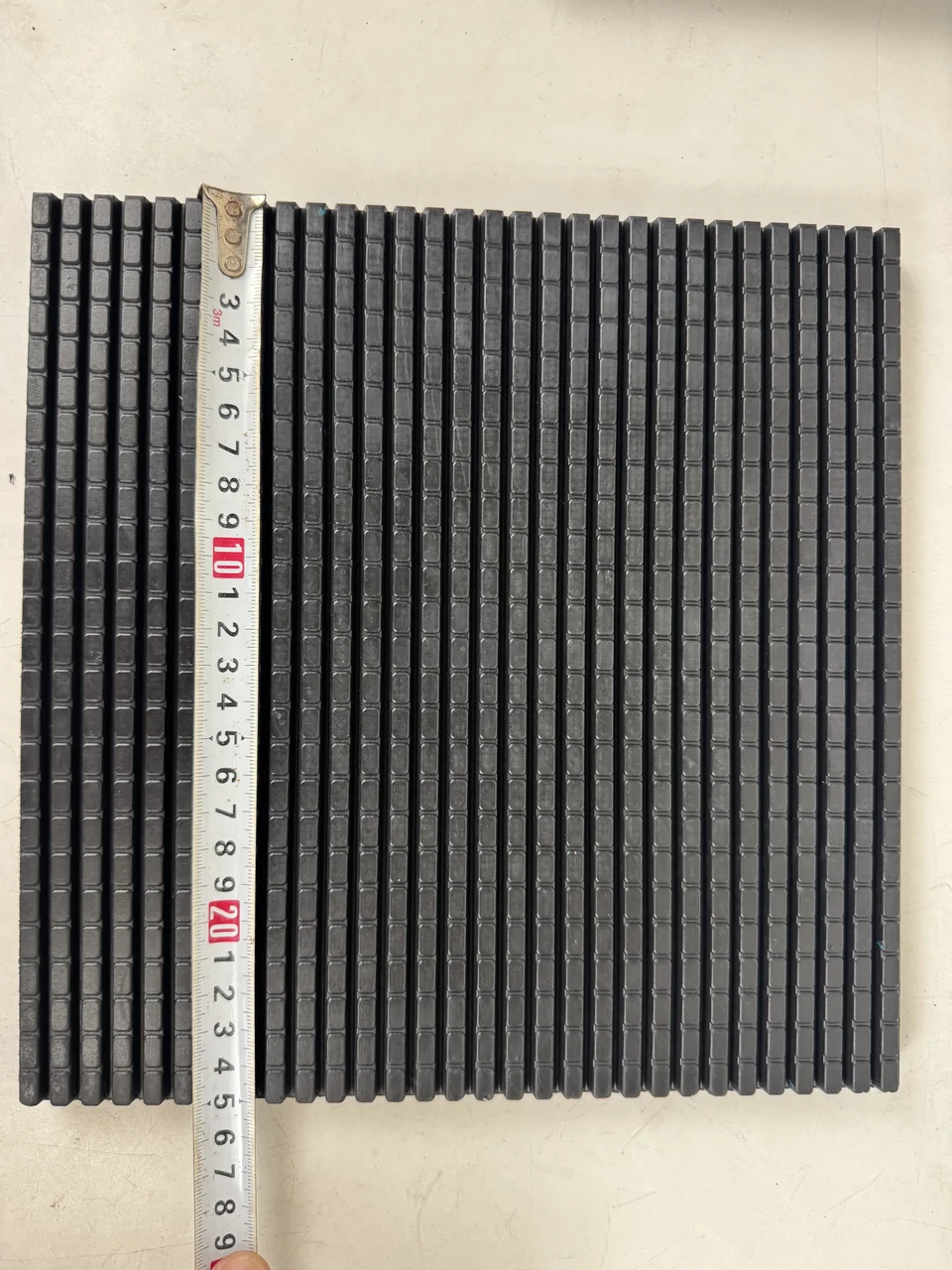
The photograph shows a dimensional check on one ribbed sample. It is not a hardness test or a load-capacity test.
4. Prepare your quotation request
- Preferred model, required length × width × thickness and drawing or sample.
- Equipment type, total weight, support-point count and load at each point if known.
- Installation arrangement, equipment speed or excitation frequency if known, and the cushioning or vibration concern.
- Material, Shore A hardness, tolerances and operating environment.
- Trial and production quantities, packing requirements and delivery destination.
Do not assume the weight is shared equally between support points. Describe the actual arrangement so the application can be reviewed. Sample availability, minimum order quantity and lead time are confirmed for your request. Include measurement units with every dimension. If a specification is unknown, mark it as unknown and share the application, photographs and any available drawing or sample.
Send your pad requirementsCommon selection questions
Does type D have a guaranteed heavy-duty load rating?
No. The name describes its deep-groove ribbed structure. Allowable load and isolation performance require review for the actual installation.
Can type B be cut to size?
Type B uses a 6×6 raised-dot pattern with 36 dots per unit. Send the required unit size, cut lines and edge finish for confirmation against a drawing or sample.
What if the installation needs a threaded connection?
Compare mounts with male studs, female threads or plain ends. Confirm connection dimensions and load per mount separately.
Download the selection reference
Keep the existing PDF handy when comparing dimensions or preparing an inquiry. The website and PDF provide reference information; final specifications are confirmed by order.
Still comparing pads and mounts?
Compare contact surfaces, connections and selection requirements →